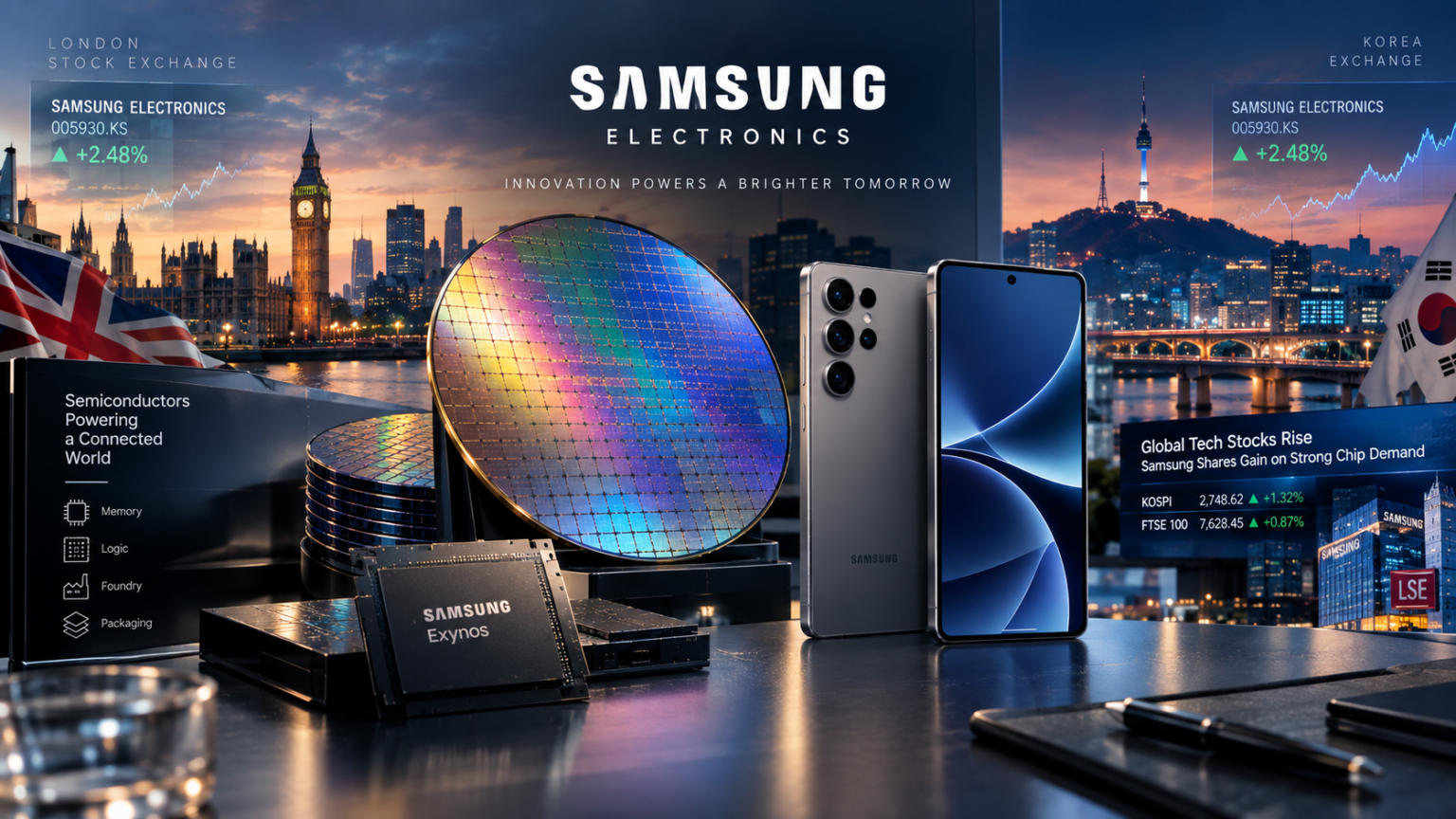
Shares in Samsung Electronics have become a popular search for investors looking for exposure to semiconductors, smartphones, displays and consumer electronics. The listing structure can be confusing because Samsung Electronics is listed in South Korea, while its global depositary receipts trade in London and US investors may encounter SSNLF. This guide explains where Samsung stock trades, how the business is performing, what can move the shares, and what investors should check.
What Does Samsung Stock Represent?
Samsung stock generally refers to Samsung Electronics Co., Ltd., the listed company behind businesses spanning memory chips, processors, displays, smartphones, TVs, appliances and other technology products. Its original common shares trade on the Korea Exchange under 005930, while preferred shares trade under 005935. Samsung also has GDRs listed on the London Stock Exchange: SMSN represents common shares and SMSD represents preferred shares.
The London listing can make the company easier to research through a familiar exchange. Samsung states that non-US investors can trade its London-listed GDRs through eligible securities firms. US residents face different rules for the LSE GDRs, so brokerage access should be checked.
| Item | Samsung Electronics |
|---|---|
| Company | Samsung Electronics Co., Ltd. |
| Main share listing | Korea Exchange |
| Common ticker | 005930 |
| Preferred ticker | 005935 |
| London common GDR | SMSN |
| London preferred GDR | SMSD |
| Main operating areas | Semiconductors, mobile, displays, consumer electronics |
Why Samsung Stock Gets Investor Attention
The business has an unusually broad technology footprint. Its Device Solutions division includes memory and other semiconductor operations, while its Device eXperience division covers products such as smartphones, TVs and home appliances.
Semiconductors are particularly significant because memory demand can change rapidly with data centers, artificial intelligence infrastructure, PCs, smartphones and broader electronics production. Samsung’s 2026 strategy also highlights high-value memory, including high-bandwidth memory, alongside foundry and advanced packaging.
The company is not simply a smartphone manufacturer. Its earnings can be influenced by chip pricing, production capacity, consumer demand, foreign exchange movements and capital spending.
Recent Financial Performance
Samsung reported record consolidated quarterly revenue of KRW 171.5 trillion for the second quarter of 2026, up 28% quarter over quarter. Operating profit reached KRW 89.5 trillion. The Device Solutions division generated KRW 127.5 trillion in revenue and KRW 89.2 trillion in operating profit, while the Memory Business reached all-time highs for quarterly revenue and operating profit.
Those figures provide useful context, but one quarter should not be treated as a permanent earnings trend. Semiconductor cycles can turn quickly, and Samsung’s disclosures note that investment requirements, business conditions and cash flows can affect future shareholder returns.
💡 Pro Tip
When reviewing the shares, compare several quarters rather than focusing on a single earnings release. Pay particular attention to memory revenue, semiconductor margins, capital expenditure, cash flow and management guidance. These measures can reveal whether a strong result reflects a broader operating improvement or a favorable point in the chip cycle.
Dividends and Shareholder Returns
Income-focused investors often search Samsung stock because the company has an established shareholder-return framework. For 2024–2026, Samsung committed to returning 50% of free cash flow generated over the three-year period, with regular annual dividends of KRW 9.8 trillion.
The company reported a second-quarter 2026 dividend of KRW 374 per common share and KRW 374 per preferred share, with a June 30, 2026 record date. Samsung also announced in August 2026 that it expects total 2026 shareholder returns of approximately KRW 90 trillion to KRW 110 trillion, subject to business performance, investment execution and cash flows.
That announcement is forward-looking, so the eventual amount can differ from the estimate. Investors should distinguish between regular dividends, special distributions and share repurchases when calculating potential shareholder returns.
What Can Move Samsung Stock?
Several factors can materially affect the shares:
- Memory-chip prices and demand, particularly from AI infrastructure.
- Semiconductor technology progress and manufacturing costs.
- Smartphone and consumer-electronics sales.
- Capital expenditure and research spending.
- Korean won exchange-rate movements.
- Global economic conditions and electronics demand.
- Competition in memory, foundry, smartphones and displays.
- Changes in dividends, buybacks or other capital-return decisions.
Samsung has also said it plans more than KRW 110 trillion of facilities and R&D investment in 2026 as part of its strategy around AI semiconductors. Large investment can support future capacity and technology, but it also affects near-term cash allocation.
How UK and US Investors Can Research Samsung Stock
The first step is identifying which security you are actually looking at. A search for the company can return different symbols depending on the market and data provider.
UK investors may encounter SMSN on the London Stock Exchange, where each GDR represents 25 common shares. US investors may see SSNLF on OTC markets, but Samsung’s official investor-relations material says US residents cannot trade its LSE GDRs under the stated Rule 144A restriction. Brokerage availability, market access, fees, currency conversion and tax treatment can therefore differ.
Check the security’s exchange, share ratio, currency and whether the instrument represents common or preferred shares. This prevents comparisons between instruments that are not equivalent.
Risks to Consider Before Buying
The shares carry the risks associated with a large global technology manufacturer. Semiconductor earnings can be cyclical, while smartphone and consumer-electronics markets face intense competition. The company also operates across currencies and jurisdictions, exposing investors to foreign-exchange and geopolitical factors.
Another consideration is valuation. A strong earnings period can change conventional valuation ratios quickly, while a weaker chip cycle can compress profits. Investors should therefore examine revenue, operating profit, free cash flow, balance-sheet strength, capital spending and valuation together rather than relying on one metric.
📌 Key Takeaway
Samsung stock gives investors exposure to a diversified technology business, with semiconductors playing a major role in recent results. The key research points are the listing being considered, semiconductor conditions, earnings quality, capital spending, dividends and shareholder-return plans. Current figures should always be checked against Samsung’s latest investor-relations disclosures before making an investment decision.
Frequently Asked Questions
Is Samsung stock publicly traded?
Yes. Samsung Electronics’ original common and preferred shares are listed on the Korea Exchange, and the company has common and preferred GDRs listed in London.
What is Samsung’s main stock ticker?
The common shares trade in South Korea under 005930. The London-listed common GDR trades under SMSN. Market-data providers may also show other symbols for different trading venues.
Does Samsung pay dividends?
Yes. Samsung has a regular dividend policy and announced a KRW 374-per-share dividend for both common and preferred shares for the second quarter of 2026.
Can US investors buy Samsung shares?
Access depends on the security and brokerage. Samsung says US residents are prohibited from trading its London-listed GDRs under the stated Rule 144A restriction, so US investors should check which Samsung instrument their broker supports.
What affects Samsung’s earnings most?
Semiconductor demand and pricing are major factors, but smartphone sales, consumer electronics, displays, currency movements, capital spending and broader economic conditions also influence results.
Conclusion
Researching Samsung stock requires more than checking a single ticker or daily price. The company spans several major technology markets, with semiconductor performance currently central to its financial results. Investors in the US and UK should first identify the correct security, then review the latest earnings, valuation, shareholder-return announcements and business outlook before making their own assessment.