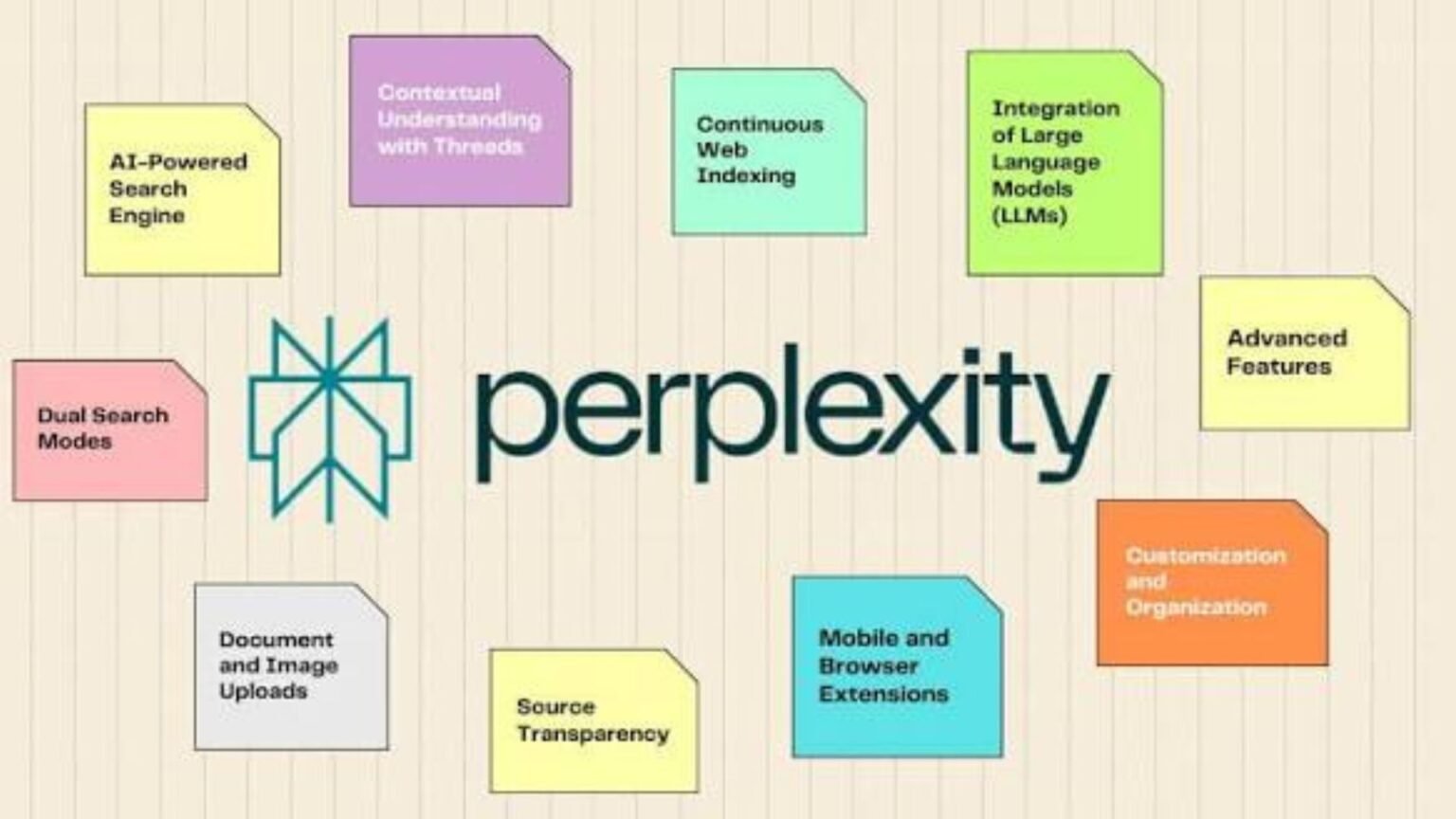
Perplexity has developed beyond a simple AI chatbot. Its core experience combines web search, language models, source citations, research tools, file analysis, and project-based workflows. The most useful Perplexity AI features are designed to help users find information, evaluate sources, continue research, and turn findings into practical outputs.
For students, researchers, professionals, creators, and curious users in the US and UK, the platform can function as an AI-powered research assistant. However, its different modes serve different purposes, so knowing which tool to use matters.
What Makes Perplexity Different?
Perplexity describes itself as an AI-powered answer engine. Instead of primarily returning a conventional list of search results, it searches the web and synthesizes information into conversational answers with links to sources.
That source-first approach is one of its defining characteristics. Users can inspect citations, open original pages, and continue asking questions without starting a completely new search.
Another advantage is model flexibility. Depending on the plan and feature, Perplexity can provide access to multiple advanced AI models, allowing users to choose or automatically route queries to suitable models.
Key Perplexity AI Features
1. Real-Time Web Search
Perplexity searches current web information when answering questions, making it useful for subjects that change frequently, such as technology, news, products, companies, and travel. Its answers include citations that make checking the underlying information easier.
This is particularly useful when a static knowledge base might be outdated. Still, citations should be opened and evaluated rather than treated as an automatic guarantee that every statement is correct.
2. Pro Search
Pro Search is intended for questions requiring more depth than a quick lookup. It performs multiple searches, draws information from different types of sources, and synthesizes the findings into a more detailed response.
It can also support specialized searches, including academic, financial, web, and file-based research. Advanced capabilities include model selection, reasoning models, and code interpretation, depending on availability and subscription level.
3. Deep Research
Deep Research is one of the strongest options for complicated research tasks. Perplexity says the feature can conduct dozens of searches, read hundreds of sources, reason through the material, and produce a comprehensive report.
A 2026 update expanded its capabilities to include calculations, improved code-sandbox analysis, uploaded-document processing, and broader web access.
This makes it better suited to market research, academic investigation, comparisons, and other questions where a single search would not provide enough context.
4. File and Document Analysis
Users can upload files and use Perplexity to analyze their contents alongside their questions. This can be useful for extracting information, summarizing documents, comparing material, or asking targeted questions about a file.
For professional work, this changes the workflow from simply searching the public web to combining external information with your own documents.
5. Projects
Projects provide persistent workspaces for longer-running tasks. A Project can keep conversations, files, custom instructions, Computer tasks, connected tools, and accumulated context together in one place.
This is helpful for recurring research. For example, a marketing team could maintain a Project for competitor research rather than scattering related conversations across separate searches.
6. Create Files and Apps
Perplexity also supports a creation workflow that can turn natural-language instructions into outputs such as reports, spreadsheets, dashboards, and simple web applications. The system can combine web research, code execution, and other tools while building these deliverables.
This is an important distinction: the platform is increasingly designed not only to answer questions but also to help produce usable work.
💡 Pro Tip: For a research-heavy task, start with a narrowly defined question and specify the desired output. Asking for a comparison with source links, decision criteria, and a concise recommendation generally produces a more useful result than a vague request to “research everything.”
Which Feature Should You Use?
The right choice depends mainly on the complexity of the task.
| Feature | Best for | Main advantage |
|---|---|---|
| Standard Search | Quick questions | Fast, current answers |
| Pro Search | Detailed research | Multiple sources and deeper synthesis |
| Deep Research | Complex investigations | Autonomous multi-step research |
| File analysis | Personal documents | Questions grounded in uploaded material |
| Projects | Long-term work | Persistent context and organization |
| Create files and apps | Deliverables | Turns instructions and research into outputs |
For a quick factual question, standard search may be enough. A complicated market comparison is more appropriate for Pro Search or Deep Research. If the work involves repeated research and shared materials, Projects can provide a more organized environment.
Where Perplexity Works Best
The platform is particularly useful when the goal is finding and understanding information quickly.
Common use cases include:
- Academic and literature research
- Competitor and market research
- News discovery
- Product comparisons
- Travel planning
- Technical questions
- Document analysis
- Data-oriented research
- Creating reports and other working documents
Its conversational follow-up system also means you can refine an initial answer rather than repeatedly rebuilding the same search.
Limitations to Keep in Mind
Perplexity AI features can reduce research time, but they should not eliminate human verification.
AI-generated summaries can misunderstand a source, overlook context, or make an incorrect inference. A citation tells you where supporting information came from; it does not automatically prove that the generated interpretation is correct.
For medical, financial, legal, academic, or other high-stakes work, verify important claims against the original source and authoritative information.
Access also varies by subscription. Free users can access core functionality, while paid plans provide greater access to advanced search, models, file capabilities, and creation tools.
📌 Key Takeaway
The strongest Perplexity AI features are not simply about generating answers. They combine current web information, citations, deeper research, file analysis, persistent Projects, and creation tools. The best experience comes from matching the feature to the complexity of the task and checking important sources yourself.
Frequently Asked Questions
Is Perplexity better than Google for research?
Perplexity and Google serve different purposes. Google is excellent for discovering websites and navigating the broader web, while Perplexity focuses on synthesizing information into conversational, cited answers. For research questions that require comparing multiple sources, Perplexity can reduce the amount of manual reading needed.
Is Perplexity free to use?
Perplexity offers free access to its core search and conversational experience. Advanced capabilities, higher usage limits, and some premium tools are available through paid subscriptions. Exact access can change as the service introduces or modifies features and plans.
Does Perplexity provide sources?
Yes. Perplexity’s answers generally include citations and links to underlying sources. This allows users to inspect the original material and verify important claims rather than relying entirely on the generated response.
What is Perplexity Deep Research used for?
Deep Research is designed for complex questions requiring multiple searches, source evaluation, reasoning, and report generation. It is especially useful for detailed investigations where a quick answer would not provide sufficient evidence or context.
Can Perplexity analyze uploaded files?
Yes. File analysis allows users to provide documents as part of their research workflow. Advanced research capabilities can also work with uploaded documents while combining them with broader web research.
Perplexity’s direction is clear: it is becoming a broader research and productivity platform rather than only a conversational search tool. The most valuable Perplexity AI features are those that connect discovery with analysis and finished work. For simple questions, use search; for complex investigations, move to Pro Search or Deep Research; and for ongoing projects, use persistent workspaces and file-based workflows.